
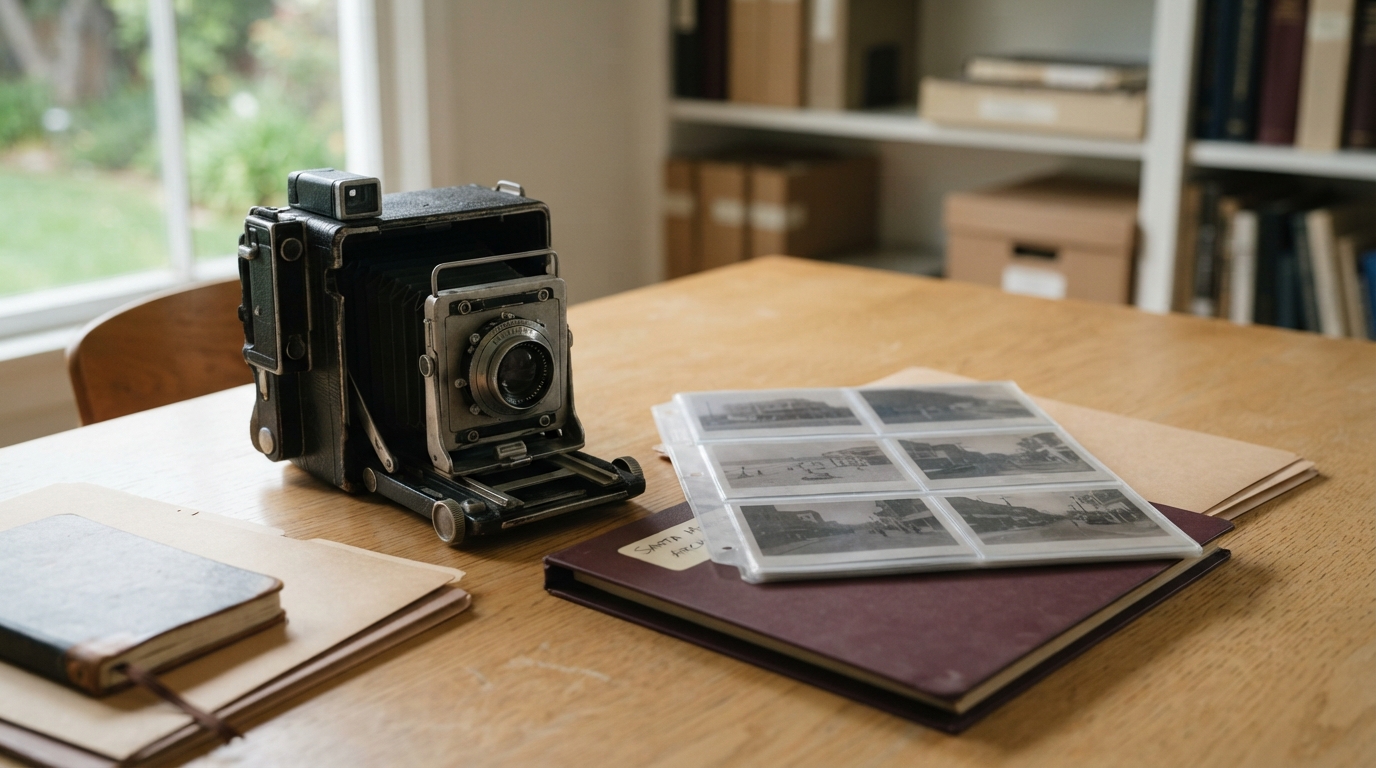
A shoe shop, a business district, and a wartime registration photograph may seem like unrelated subjects. In the Bill Beebe Collection at the Santa Monica History Museum, they offer different entry points into the city’s past. Together, these records invite readers to look beyond familiar landmarks and consider the working lives, public activities, and changing streets that shaped Santa Monica.
The collection rewards more than a nostalgic glance. A date, a photographer’s credit, or a catalog number can turn an intriguing image into evidence worth investigating.
What Is the Bill Beebe Collection?
The museum’s historical photographs overview describes the Bill Beebe Collection as negatives documenting the area from the 1930s through the 1960s. They were produced by photographers working for Pacific Press, a photographic service supplying the Santa Monica Outlook, Los Angeles Times, Los Angeles Herald, and Los Angeles Examiner.
Importantly, the collection includes work by Bill Beebe, Emerson Gaze, and Bill Anderson. Its name is therefore not proof that Beebe personally photographed every image. When discussing an individual photograph, keep its collection credit separate from any confirmed photographer attribution.
The museum also lists the Outlook Collection separately, describing its newspaper image archive as covering 1965 through 1998 alongside earlier photographs. These related holdings should not be treated as interchangeable collections.
That distinction gives research a clearer starting point. Record the collection name and item number before following a subject across other sources. A shared newspaper connection is useful context, but it does not replace an individual record.
Storefronts That Put History on the Map
The museum’s Then and Now photographs make several Bill Beebe Collection images approachable through dated comparisons. They offer specific locations to investigate rather than an imagined picture of what the entire city once looked like.
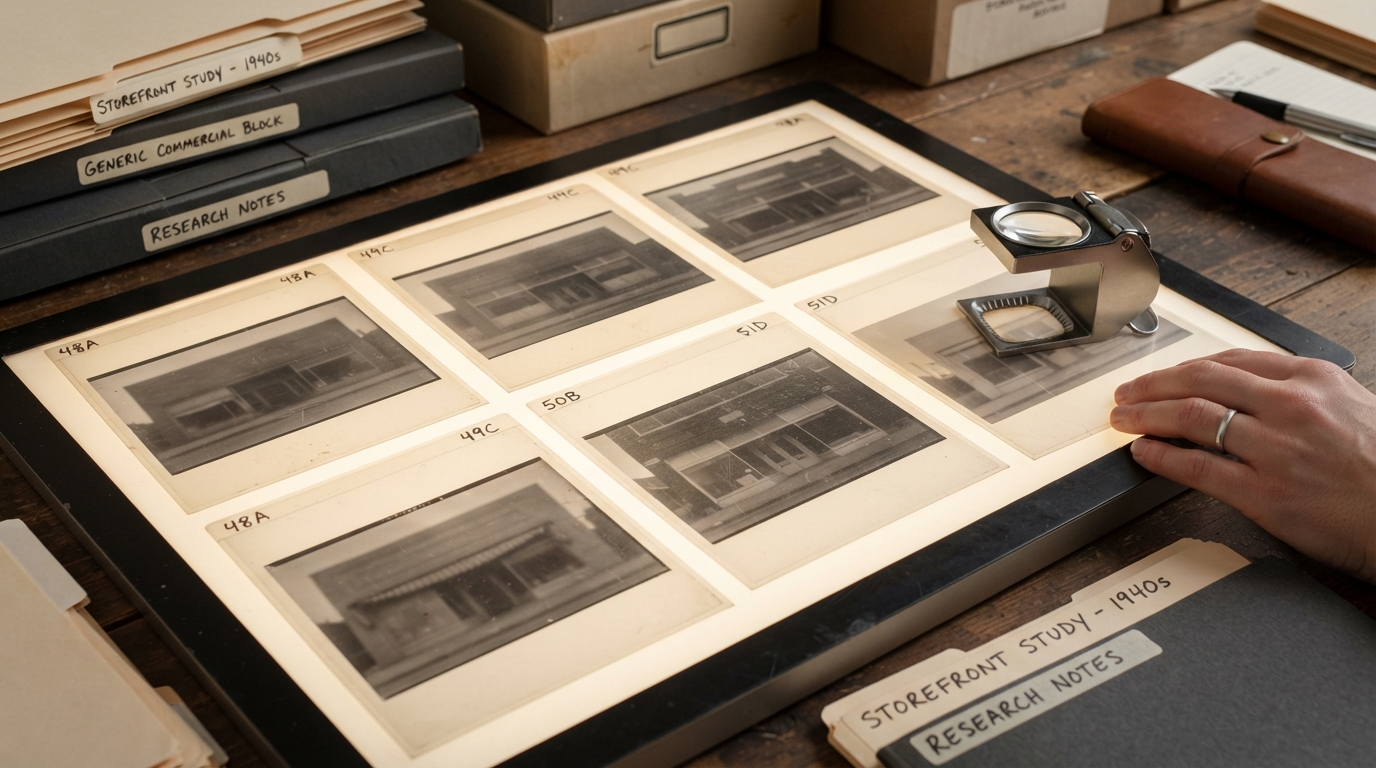
Whitman’s Shoe Store and the Business District
One comparison identifies Whitman’s Shoe Store at 1329 Third Street in 1940, catalog number 3.2.2008. Another identifies the business district at Third Street and Santa Monica Boulevard in 1938, catalog number 3.2.17. Both are paired with photographs dated 2016.
These examples invite different scales of observation: the individual shop and its wider commercial setting. Compare entrances, window arrangements, building outlines, and the relationship between pavement and storefront. Which details appear continuous, and which require another source to explain?
Fisher-Swartz Lumber Company
A further comparison pairs a 1935 Fisher-Swartz Lumber Company photograph, catalog number 3.2.502, with a 2016 view. It introduces another subject for studying the city’s working environment, beyond shopping streets alone.
The dates deserve attention. The modern-looking images in these examples document 2016, not the present day. Before describing a building’s current appearance or occupant, seek newer evidence. Likewise, a changed facade does not by itself explain when ownership, use, or construction changed.
A Wartime Photograph Beyond Celebrity
The collection also appears in the museum’s Herstory exhibition material. Its caption identifies actor Anna May Wong signing up for a Civil Defense volunteer organization during World War II. The photograph is dated December 1942 and credited to the Bill Beebe Collection, number 3.2.2644.
This example suggests a different way to approach a familiar name. Rather than stopping at celebrity recognition, consider how the documented action connects an individual with wartime civic participation. The caption supplies a subject, an activity, and a date that a general impression cannot provide.
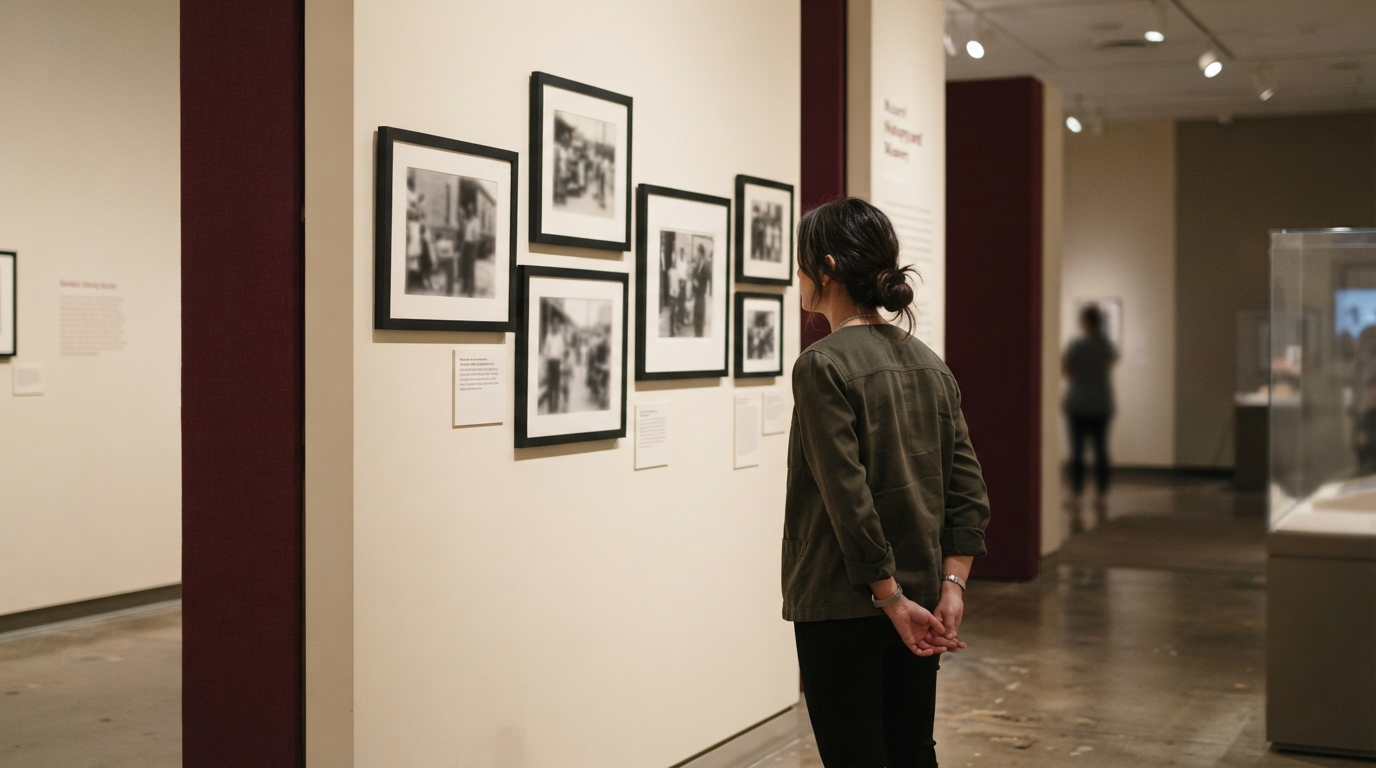
It also shows how an archival photograph can contribute to a later exhibition about women’s histories. The source remains the same, while the questions readers bring to it can expand. Interpretation becomes richer when the original identifying information stays attached.
How to Read an Archival Photograph
The National Archives’ photograph analysis guide begins with observation, then asks readers to examine context and consider other evidence. It provides a practical framework for exploring museum photographs without rushing toward a conclusion.
Separate Observation From Interpretation
Imagine noticing several people gathered outside a doorway. Their presence is an observation; deciding that they are customers waiting for a sale is an interpretation. Look for a caption, an accompanying article, or another record before treating that explanation as established.
Try writing two short notes for one collection image: what you can directly identify and what you still want to know. Pay attention to the edges of the frame as well as the main subject. Then ask what the photograph cannot show about the occasion.
For a student project, choose one manageable question rather than a sweeping claim about a neighborhood. Explaining how a particular image supports a limited conclusion is more useful than attaching a dramatic story that its evidence cannot sustain.
Follow the Image Into Other Records
The museum’s Morley Builders Research Library lists maps, telephone directories, yearbooks, and bound Outlook newspaper editions among its resources. Its research library and special collections are available by appointment, so check the museum’s arrangements before planning an in-person investigation.
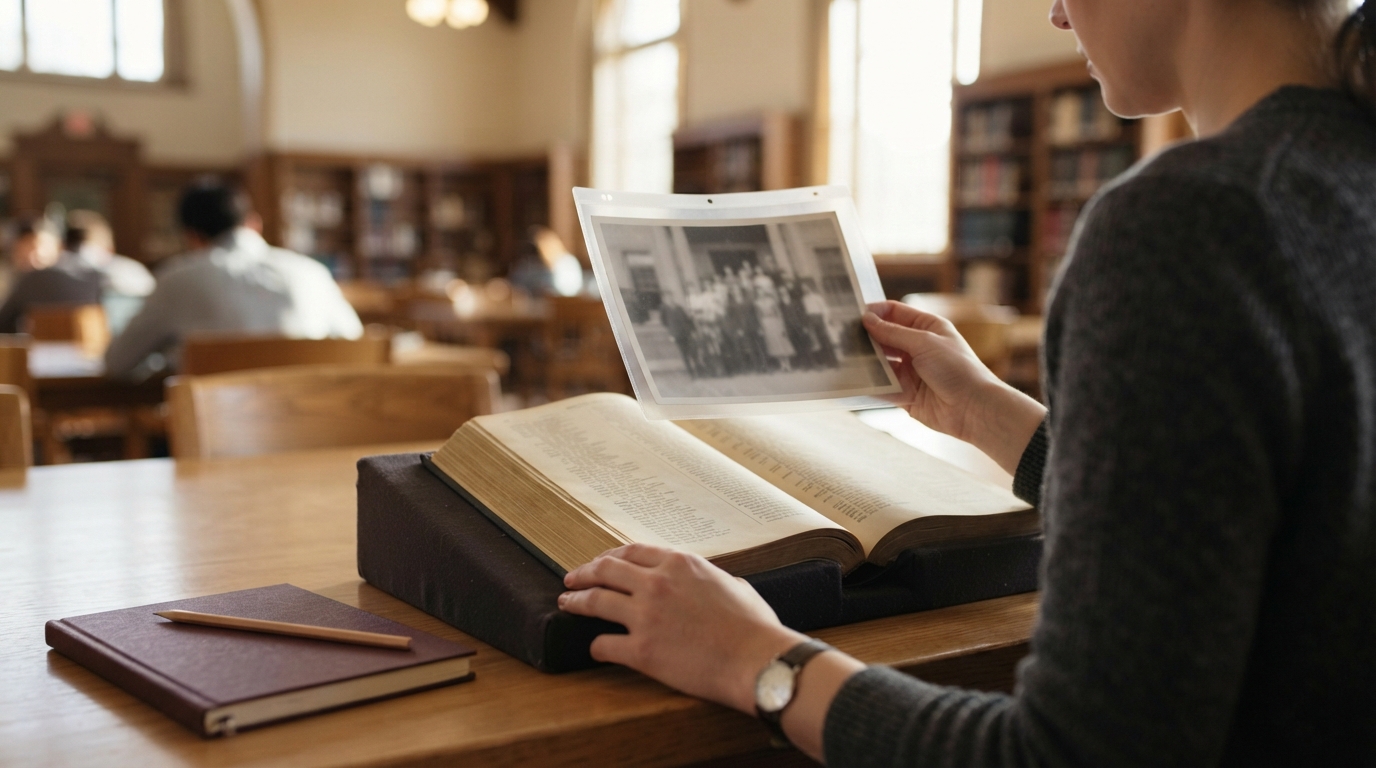
For a storefront photograph, look for a directory entry matching the recorded business name and date. A map may help establish the location, while a newspaper item might explain an opening, alteration, or public event. Treat these as possible research paths, not promises that matching records survive.
Our article about the Corona typewriter in the Outlook Collection explores the relationship between newspaper history and museum objects. Read alongside photographic records, it encourages attention to both the information newspapers presented and the tools associated with their production.
Keep a simple research trail containing the image title, catalog number, stated date, and sources consulted. Mark unresolved questions clearly so that a later discovery can revise your interpretation without obscuring the original evidence.
Reproductions and Responsible Sharing
The museum’s photo reprint and reproduction guidance explains its ordering process and conditions for public use. Before publishing an archival image, confirm the applicable permission and credit requirements for your intended project rather than assuming that online visibility permits reuse.
For an article about this collection, choose a documented reproduction when available and retain its identifying caption. A generated historical-looking scene should be labeled as an illustration, never presented as a recovered Bill Beebe Collection photograph.
The collection’s appeal lies in these identifiable connections between an image and a recorded place, person, or moment. Browse our Photographs & Archives section for further collection-focused reading, and let a carefully examined detail become the beginning of your next historical question.
This article is published by an independent museum journal. It is not affiliated with or operated by the Santa Monica History Museum.